How to Celebrate the Fourth of July, Catholic-Style

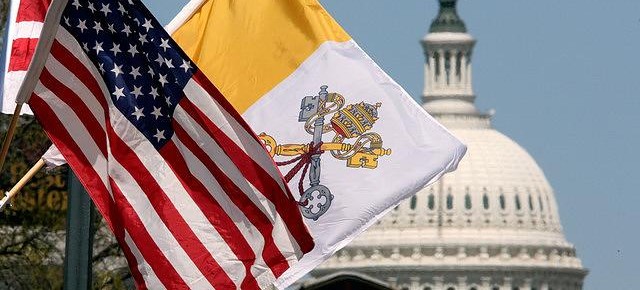
Vatican-and-American-flag-640x290
With a long Fourth of July weekend upon us, you may be wondering how to combine your celebration of Independence Day with your Catholic Faith. Wonder no more. Here are three suggestions:

1.   Honor the Catholic Contribution to the Declaration of Independence. You can learn of two such contributions in Brian Burch and Emily Stimson’s wonderful book, The American Catholic Almanac.

First, Thomas Jefferson’s phrase “all men are created equal” was inspired by an Italian Catholic named Philip Mazzei who wrote to Jefferson that “all men are by nature equally free and independent.” (Come to think of it, I like Mazzei’s wording better than Jefferson’s, as it strikes me as more accurate.) The U.S. Post Office honored Mazzei in 1980 with a stamp, but you can honor him with a drink. How about a wine from Mazzei’s native Tuscany, or any wine you can find from Virginia, since it was Mazzei who “taught Virginia’s planters how to cultivate vineyards”? Quievremont wines, for example, are made in northern Virginia by the Guevremonts, a good Catholic family whose adult son I had the pleasure of meeting at the book launch for DWTS in May. Mazzei can also be toasted with London dry gin (placed, for instance, in a gin and tonic), since he was running a successful business in London when he met Benjamin Franklin and was persuaded to move to the American colonies.

Or you can honor Charles Carroll (1737–1832), the last surviving signer of the Declaration of Independence who also happened to be the only Catholic signatory. Carroll was not only the lone papist who signed the Declaration, he was also the wealthiest, which means that he had the most to lose in this risky political venture. There are twelve counties and two parishes in the U.S. that are named after Carroll, including Carroll County, Iowa, which recently began boasting of an Iowa Legendary Rye that hearkens back to the days of Prohibition. And if you’re feeling lucky, you can try to track down a craft beer made in a Carroll county or parish, as there surely must be some out there.
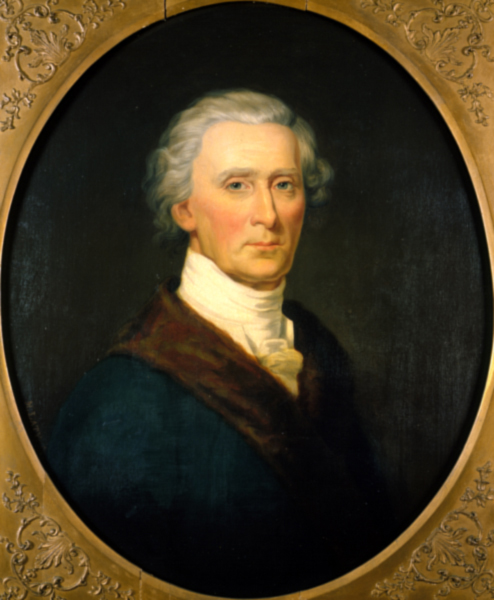
1846.2.1-Charles Carroll of Carrollton (1737 - 1832), Oil on Canvas Michael Laty  (1826 - 1848), ca. 1846 Copy From Original Owned By The Maryland Historical Society. No Reproduction Without Permission

1846.2.1-Charles Carroll of Carrollton (1737 – 1832), Oil on Canvas Michael Laty (1826 – 1848), ca. 1846
Copy From Original Owned By The Maryland Historical Society. No Reproduction Without Permission

2.  Honor American Saints. Let us by all means raise a glass to our Founding Fathers, but we can fill that glass with a cocktail commemorating an American Catholic saint. How about a Manhattan for Mother Cabrini, the first U.S. citizen to be canonized (page 354 of DWTS)? Or what about honoring the first native-born U.S. citizen to be canonized, St. Elizabeth Ann Seton? True, we assigned her a cocktail called the Benedict Arnold (page 386) because her family were loyalists during the Revolutionary War, but we can forgive her for her family’s politics if she can forgive us for pairing her with Benedict Arnold. Lastly, you can honor the Jesuit North American Martyrs, the first to shed their blood for the Faith on these shores, with a summer-friendly Saratoga Fizz (page 260) or a DWTS original cocktail called the Black Robe (page 261). “Black Robe” was a native American nickname for the Jesuits.

3.  Honor the Holy Popes. Huh? Honor Popes on a day when everyone else is thinking of George Washington or Thomas Jefferson or John Adams? There just so happens to be an old optional feast that falls on July 4 known as the Commemoration of All Holy Popes. By our count, 80 out of the 266 Popes in history are canonized saints, which is not too bad. Pick whatever drink you want, toast to the good leaders we have had as Americans and as Catholics, and pray to God for more.
JP II and John XXIII
Oh, and you can also sing “God Bless America” in Latin, with a translation by yours truly.

Beet Americam, amatam Deus! [the first word is pronounced BAY-et]
Teneatque, foveatque,
Per noctem in lucem supernam,
A montanis, usqu’ad prata, usqu’ad mare spumosum.
Beet Americam, dulcem Patriam!
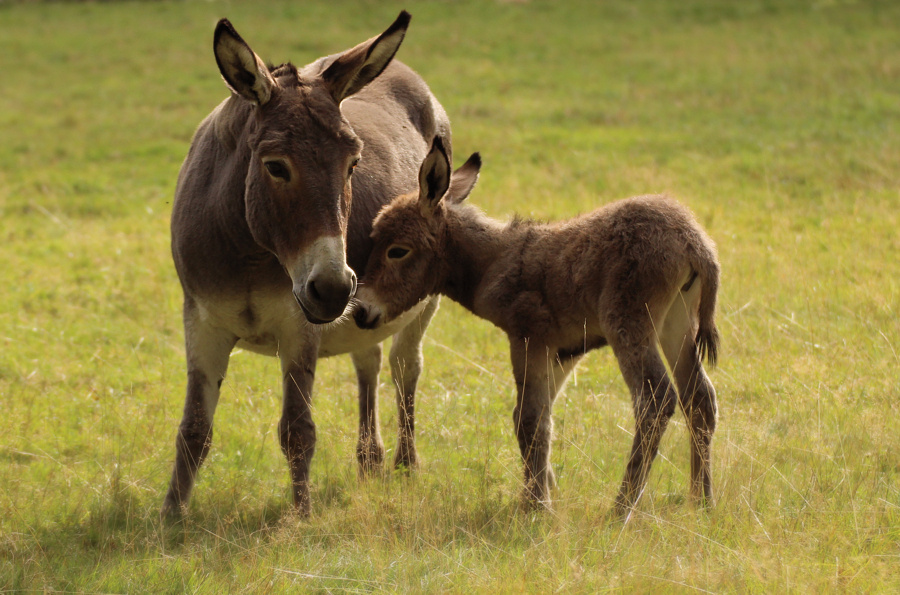
The Wolf and the Donkey

donkey sababurg_07  wolf 18nepvbm5hkxejpg

Today and tomorrow we celebrate two saints with ties to a donkey. St. William of Montevergine (June 25) was a hermit whose donkey, his only source of transportation, was killed by a wolf. Undeterred, St. William made the wolf his pack animal from that day forward. Surely there is a life lesson for us all in there somewhere. You can think of one as you sip the drink of the day, the Big Bad Wolf.

Big Bad Wolf
1 oz. brandy
½ oz. orange juice
1 egg yolk
¼ oz. grenadine
Pour all ingredients into a shaker with ice and shake forty times. Strain into a cocktail glass.

Tomorrow, June 26, is the feast of Opus Dei Founder St. Josemaria Escriva, who is the subject of an excellent article that came out this morning in Crisis Magazine. Saint Josemaria, who used the image of a donkey turning a waterwheel to teach how one can achieve holiness in the fulfillment of one’s ordinary duties, had a fondness for the stubborn beast of burden and even liked to call himself a mangy donkey. Inspired by this epithet, we created a cocktail in the saint’s honor bearing that name. The main ingredient is Fundador brandy, which is Spanish for “Founder.” Members of Opus Dei often refer to St. Josemaria Escriva as the Founder, but whenever he heard this, he liked to joke that the only good Founder he knew came in a bottle.

The Mangy Donkey
2 oz. Fundador brandy
½ oz. dry vermouth
1 dash orange bitters
1 orange wheel
Pour all ingredients into a shaker with ice and shake forty times. Strain into a cocktail glass and garnish with orange wheel, a symbol of the waterwheel image in the Founder’s writings.

Oh, and to make the drink really sing, use a premium vermouth like Dolin.

And if the conversation at the bar starts to grow a little dull, here is St. Josemaria Escriva’s most famous sermon (on Passionately Loving the World), and here are some fun trivia about donkeys.

Prosit!
Mike

The Launch of the Blog (Again)

Hello friends and readers,

Yesterday I chanced to read a passage in which St. Augustine discusses the meaning of “the spirits of wickedness in the high places [caelestibus]” in Ephesians 6:12. As Augustine explains, caelum is the Latin word for heaven or sky, but here it refers neither to the Heaven of eternal bliss nor to outer space but to the lower atmosphere in which birds fly. If Augustine thinks that demons are around us in the air we breathe, imagine what would he think of the blogosphere!

It is therefore with trepidation that I dip my toe into the world of the web log, and I ask that all my students whom I told to shoot me if I ever start blogging to lower their weapons and instead say a prayer for a hypocrite. My plan is to write once a week on a Thursday or Friday about matters pertaining to Drinking With the Saints, and my overall goal is to facilitate a virtual and virtuous community of like-minded folk who have a sacramental gratitude for and appreciation of Catholic fellowship and the fine art of drinking. Eventually, I am hoping that we can build upon Drinking With the Saints (heretofore DWTS) by sharing stories and swapping new cocktail suggestions, all with an end to renewing a culture of genuine festivity. Because Lord knows we need to!

This time around, my entry is an easy one: a link to an essay I wrote for the New Liturgical Movement which, by the way, is an excellent source of news and commentary on the beauty of our sacred liturgy.

Prosit!

Mike

The Drinking With the Saints App!

Thanks to the crackerjack team at Programmers on Call, you can now harness the power and the glory of Drinking With the Saints at the touch of a finger with the DWTS software app.

The app gives you five days’ worth of feast days, cocktail recipes, ingredients, and saints’ stories excerpted from the book. Easy-to-read instructions will have you bartending like a pious pro!

A general index allows you to search for any keyword, ingredient, or phrase and find their relevant page numbers in the book. For example, if you enter “gin” you will find all the cocktails that have gin as an ingredient and where they may be found in the book. A great aid to using the book!

You do not need to own the book to use the app, but the app is the perfect companion to get the most out of your hard copy or Kindle version of Drinking With the Saints.
Other features include:

  • Recipe Glass Illustrations by Lucinda Levine  cocktail
  • Your choice of following the traditional 1962 Church calendar or the new 1970/2002 Church calendar
  • Page references to the book
  • Runs on all major platforms: available in iPhone, iPad, Android, and Windows Phone versions

The DWTS app is the perfect supplement to the book. Order yours today! You can buy at:

  • iTunes (for Apple) [coming soon]
  • Google Play (for Android), or
  • The Windows Store (for Windows) [coming soon]

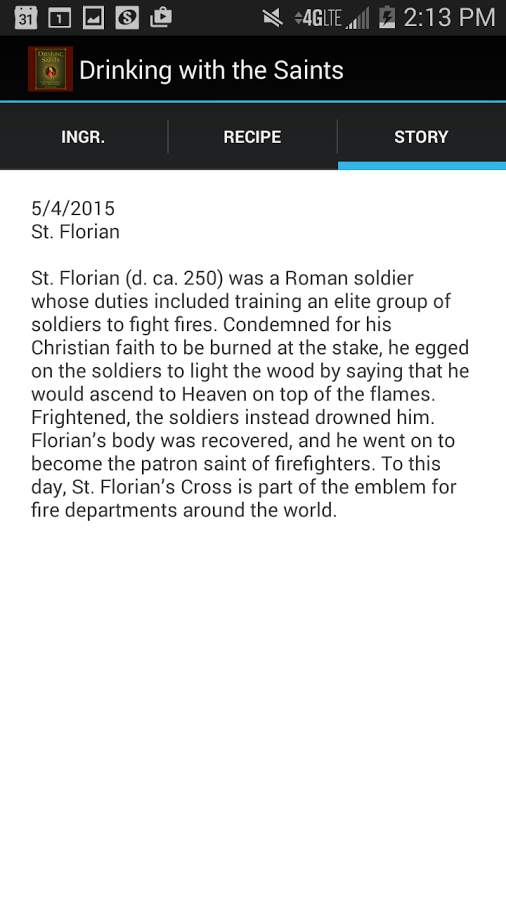
Behold sample pages for the Android version:

android1       android2       android3

android4       android5