
Philip Greene is a columnist for The Daily Beast and author of several great cocktail books including his latest due out next month, A Drinkable Feast: A Cocktail Companion to 1920s Paris (Penguin Random House). Phil is also a friend who helped me when I was writing Drinking with the Saints. Over the summer he sent me the following note:
“Hello Michael, I hope you are well. I think I solved a mystery for you; unfortunately it means you have a mistake in your book! In the drink recipe Life Blood Warmer you speculated that the initials LBW stood for the Lillet Blanc Wine. When I read that I was dubious because back in 1937 it was not called by that name, it was called Kina Lillet. I then perused the online version of the 1937 Café Royal book and discovered that the initials represent lemon barley water.”
Phil later added that if you google “lemon barley water UK,” you will see “that it was a thing, like we drink cola or lemon lime soda.”
Phil was referring to my entry for the Feast of St. Januarius (September 19), the martyr  whose dried blood is brought out every year in a phial on his feast day and which miraculously liquifies when it is placed close to his severed head (no, I am not making this up). In Drinking with the Saints I recommend an old cocktail for the feast called a Life Blood Warmer. The problem I faced was that one of the ingredients was listed only as “LBW,” which a later editor erroneously thought was an abbreviation of “life blood warmer.” I knew enough from logic that you can’t define a term with the term in the definition, so I speculated that the abbreviation stood for Lillet Blanc Wine, tested the cocktail with this ingredient, and was sufficiently pleased with the result.
But Phil is right: unbeknownst to me at the time, the term “Lillet Blanc Wine” did not exist in 1937, and lemon barley water does appear elsewhere in the famous 1937 Café Royal Cocktail Book, whence I obtained the recipe.
So it was back to the drawing board. Although lemon barley water is still common in Great Britain, it is difficult to find locally. Happily, you can make it yourself with the help of an online recipe. Here it is now:
Lemon Barley Water
 ½ cup pearl barley
water
10 cups water
1 lemon rind, grated
1 cup lemon juice
1 cup sugar
Directions
- Rinse the barley well.
- Cover barley in a pot with cold water & bring to the boil; drain.
- Return barley to saucepan with the lemon rind & 10 cups water, cook slowly for 1 hour.
- Add the lemon juice & sugar and stir until sugar has dissolved.
- Strain and chill to serve.
- Discarded barley can be mixed with some dried fruit & nuts and warm milk and makes a great breakfast.
- This recipe takes about 70 minutes and makes approximately 1⅞ liters.
The recipe I included in DWTS (with Lillet) is still pretty good, so now we have two options. I foolishly took the Pledge for the whole of this Embertide week, so I won’t be able to do a taste test. Any volunteers? Here are the two recipes:
(Original) Life Blood Warmer
From the 1937 Café Royal Cocktail Book
½ oz. lemon barley water
½ oz. orange juice
1¼ oz. gin
½ oz. Cointreau
Pour all ingredients in a shaker with ice and shake forty times. Strain into a cocktail glass.
(New) Life Blood Warmer
By a sincere but misguided Mike Foley
½ oz. Lillet Blanc wine
1 oz. orange juice (½ oz. more than the original recipe)
1¼ oz. gin
½ oz. Cointreau
Pour all ingredients in a shaker with ice and shake forty times. Strain into a cocktail glass.
Last Call
A toast in gratitude to those who correct us: Through the intercession of Saint Januarius, may our blood never boil when they point out our mistakes.





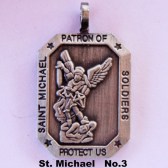 Cocktails. St. Michael is the patron saint both of the U.S. armed forces and of the faithful departed, the first because of his role in defeating Satan and the second because he is the angel who escorts souls to their eternal reward. The St. Michael’s Sword cocktail is a DWTS original. According to an old Irish legend, when Michael cast Lucifer out of Heaven, the devil fell on a blackberry bush and cursed and spat on the blackberries, thereby rendering them sour after September 29, the feast of Michaelmas. The St. Michael’s Sword contains blackberry brandy, as well as Jim Beam Devil’s Cut Bourbon, which comes in military-strength 90 proof. The “Angels’ share” is the portion of the whiskey that escapes into the air during distillation, but the “Devil’s cut” is the portion that seeps into the wood of the barrels. Jim Beam’s claims to have stolen this cut back from the Devil, and so we gratefully offer this portion to St. Michael for a job well done.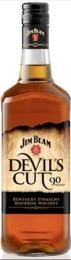
 A group of people staring blankly at the sky until a couple of angels snap them out of it: let’s hope that is not a description of a typical Drinking with the Saints party. But it’s not hard to resist the temptation to celebrate the Ascension of our Lord, which was no mere “mission accomplished” celebration but the final phase in our redemption, when Christ opened the gates of Heaven for mankind for the first time. So regardless of whether you celebrate this Feast on a Thursday or a Sunday, you need to celebrate.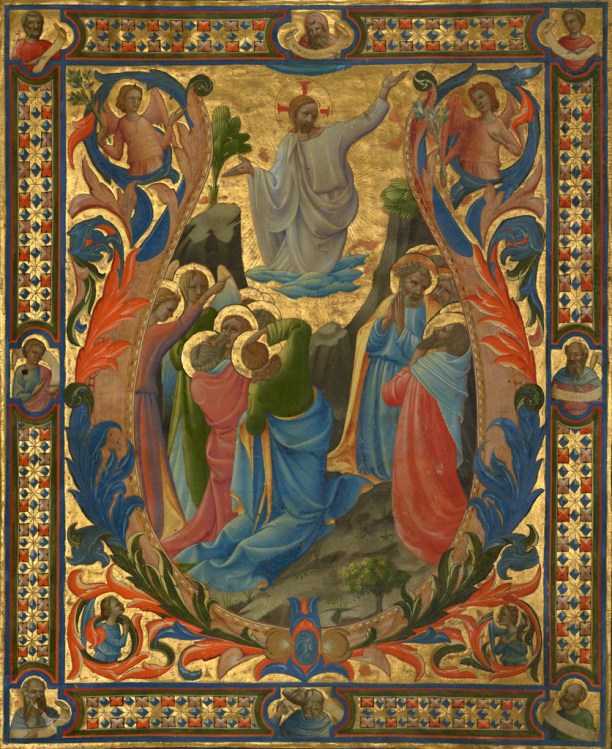
 We’d like to follow the precedent too, in our own special way. Tonight, have a drink associated with a bird. It could be a cider like Woodpecker, a lager liked Golden Eagle, or a wine like Rex Goliath (named after a rooster). Or why not lift an old page from American popular culture and have a bottle of Cold Duck? In the 1970s it was one of the best-selling sparkling wines in the U.S., with two million cases of E&J Gallo’s André Sweet Sparkling Red Cold Duck sold every year. Cold Duck can be traced to a Bavarian custom of mixing cold sparkling Burgundy with bottles of already-opened champagne. The practice, which was called cold end (kalte ende), came to be known as cold duck (kalte ente).
 hoary volumes of mythology and use as a symbol of our risen Lord flying out of the ash-heap of death up to the right hand of the Father. (Plus, it’s a good cocktail.)
 If you missed the feast of St. Francis de Sales on January 24 on the new calendar, take heart: God has given you a second chance today with the feast of St. Francis de Sales on the traditional calendar (January 29). And St. Francis de Sales is worth celebrating: appointed Bishop of Geneva over an area that had become overwhelmingly Calvinist, he won back 70,000 souls to the Church through his patience, hard work, and gentleness: hence one of his nicknames, “The Gentleman Saint.” St. Francis is also called the “Doctor of Charity” for his keen psychological understanding of love and the human heart. Check out his Introduction to the Devout Life and you will readily agree.


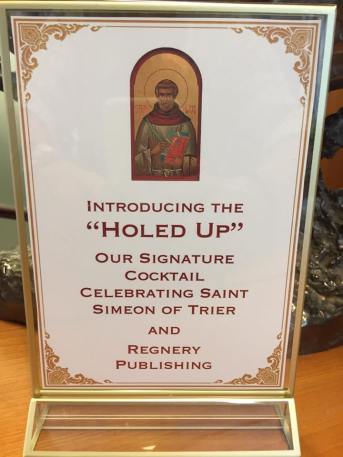
 egnery may have also known that the Porta Nigra’s most famous occupant was a medieval recluse named Saint Simeon of Trier, a native of Sicily who received permission to be sealed up in a cell high in the gate tower from 1028 until his death in 1035. Not everybody understood Simeon’s vocation, and so when a flood ravaged the city and the nearby countryside, suspicious townsfolk assumed Simeon was a trouble-making sorcerer and pelted his cell with stones, breaking its only window. But Simeon persevered, and when he eventually died, he was buried in his cell in accordance with his wishes. Soon after numerous miracles were attributed to him, and not long after his death, the Porta Nigra was converted into a church, thus saving it from being destroyed by scavengers who used old buildings as quarries.
 The Amarena cherry is in memory of St. Simeon’s homeland of Italy. Riesling wine honors the famous Mosel region of Germany, where Wilhelm Regnery worked as a winemaker and where St. Simeon spent his final years, while Blüfeld honors the color blue, the original color of conservatism before some nincompoop at NBC screwed things up with his “red” and “blue” states. Elderflower liqueur pays tribute to the wisdom of the elders which St. Simeon and Regnery have sought to conserve. And bitters reflect the bitter truth to which St. Simeon and Regnery are committed in season and out, despite all angry mobs.
 poor women known as the zie di San Gennaro (aunts of St. Januarius) “make themselves specially conspicuous by the fervour, and sometimes, when the miracle is delayed, by the extravagance, of their supplications.” When the saint’s melodramatic aunts cannot convince him to effect the desired miracle, impending disaster is predicted. In 1941, when the dry red powder in the phial failed to liquefy, Mt. Vesuvius erupted.

 Drinking With The Saints